

College t-shirts have always been a symbol of pride, identity, and belonging. From orientation through graduation, students collect them as souvenirs of their campus experience and wear them proudly to show their affiliation. Recently, however, some institutions are rethinking the traditional T-shirt giveaway in favor of a more intentional approach: the t-shirt swap.
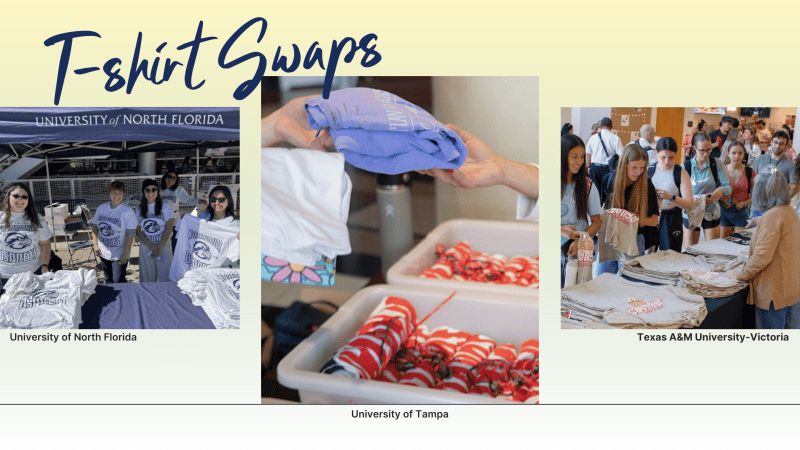
A t-shirt swap asks students to bring in a shirt they no longer wear, often from another college or university, and exchange it for a new branded campus tee. What seems like a simple exchange becomes something more meaningful. The school earns a place in the student’s everyday wardrobe, and the student participates in an experience that reinforces connection and community.
Sustainability with a Purpose
T-shirt swaps naturally support sustainability efforts. By collecting and redistributing existing apparel, colleges help extend the life cycle of garments and keep wearable clothing recirculating. When collected shirts are donated to local charities, the impact reaches beyond campus and into the surrounding community.
This approach aligns with growing student interest in environmental responsibility and social impact. Events that visibly promote reuse and reduce waste demonstrate sustainability in action, rather than as an abstract goal.
Where T-Shirt Swaps Fit on Campus
Institutions have successfully incorporated T-shirt swaps into a variety of moments throughout the academic year:
- Orientation and campus tours that welcome new and prospective students
- Transfer student events that help new arrivals feel connected
- Homecoming celebrations that tap into school pride and nostalgia
- Game day or rivalry events that encourage participation and energy
Some colleges host t-shirt swaps during National Transfer Student Week, celebrated each year during the third week of October. These events allow transfer students to trade a shirt from their previous institution for a new campus tee, marking their transition and reinforcing a sense of belonging at their new school.
Real Examples from Campus
Several universities have already embraced the concept. The University of Tampa hosts an annual T-shirt exchange during its Week of Welcome, collecting shirts from other institutions and donating them to charity. Texas A&M University–Victoria held a President’s T-Shirt Swap, exchanging campus apparel for shirts from another institution, with all collected shirts donated to the Salvation Army. The University of North Florida also incorporated a T-shirt swap into its homecoming programming.
More Than a Giveaway
At their best, t-shirt swaps turn branded apparel into a shared experience. They support sustainability goals, create meaningful engagement opportunities, and help students feel connected to their institution and community. For colleges seeking to align student engagement with values-driven programming, the t-shirt swap is a simple yet lasting idea.