

With the continuing increasing costs to operate a university, the need to build endowments continues to rise. Even though universities have long developed strategies to fundraise, new options and ideas are necessary. With the vast majority of donors being a static group, rolling out fresh campaigns can spur additional excitement, engagement and create positive results.
One fresh strategy for time limited campaigns (like Giving Days) is to employ a branded merch choice strategy when donors give to the university. This strategy takes advantage of the power of branded merch to drive donations and levels it up another notch to create additional excitement, engagement and increase the size of the donations.
A choice strategy entails offering the donor a few product options to choose from when they give a certain amount. This is different from tiered giving strategies, where the more you give, the higher level or additional merch you receive. However a tiered strategy can be deployed into a choice campaign (more on this to come).
 Colleges have long understood that branded merch drives donations for colleges. It is proven that humans make decisions based on emotions. The emotional connections that donors have to their college drive their desire to give back. The merch they receive with their donation provides a coveted and tangible way for donors to showcase collegiate pride.
When colleges strategize about incorporating branded merch into their fundraising efforts, they need to consider which donors they aim to incentivize. Generally, there are three types of donors:
- All In – This is the group of donors that will likely give no matter what.
- On the Fence – The donors that can be swayed and incentivized to give.
- All Out – Donors who will basically not give no matter what.
 The logical focus is to target the group that is the “On the Fence” group. While there are a number of strategies used to increase donations from this group, branded merch is often deployed into this strategy. There is a cost to universities to invest in merch to drive these donations, it is recognized that it is a net positive. The merch drives more donations that otherwise would not have occurred and has shown to more than pay for itself.
Thus when colleges are using branded merch to drive additional donations, they know a portion of the donors will be basing their decision off of the chosen item. Consequently, the success of the campaign can ride on how well the chosen merch drives donations. That is a lot of pressure to get this right!
To not only mitigate this risk, but to increase the chances of the branded merch being even more impactful in driving donations, offering a merch choice for a donation should be considered.
When we did our proprietary research on why donors give to colleges, we asked “if given a merch choice, would it increase your likelihood of giving?“ The data is clear with 50% of respondents saying they would be even more likely to give. Use this insight to drive more donations and the success of campaigns.
When a choice of branded merch is available, it opens up opportunities in two key areas that would have otherwise been closed when just one product is offered:
- Wider Selection – When merch is selected for all donors, for it to be impactful, it needs to be desired by a wide audience. The challenge here is that those products tend to be tried and true. Products that are more niche (as we covered in a recent post) that may create excitement amongst a select group of donors, will never be considered. The tried and true items may become stale over time and by providing a wider selection of products, the campaigns can continually remain fresh.
- Artwork Variety – The artwork on the product can be just as impactful with the decision to donate as the product itself. What is imprinted on the product provides the emotional connection (otherwise it is just a product). With just one option to choose from, there will be a percentage of donors who will or will not be swayed to donate based on the artwork. With a variety of merch offered, the campaign can lean into a variety of artwork to broaden its impact.
For the donor group on the fence, if they shrug at the merch offered and decide to not donate, that is money left on the table. This does not need to happen. By providing choice, through both the product and the artwork, colleges can lean into a wider range of options that can include targeting different demographics, personal taste and niche items.
Providing merch choice can be done with minimal extra cost and time invested with impactful results, while also being lucrative.
So, how can colleges best execute a merch choice giving strategy to maximize these benefits? Let’s dive into the strategies and recommendations to ensure giving campaign success.
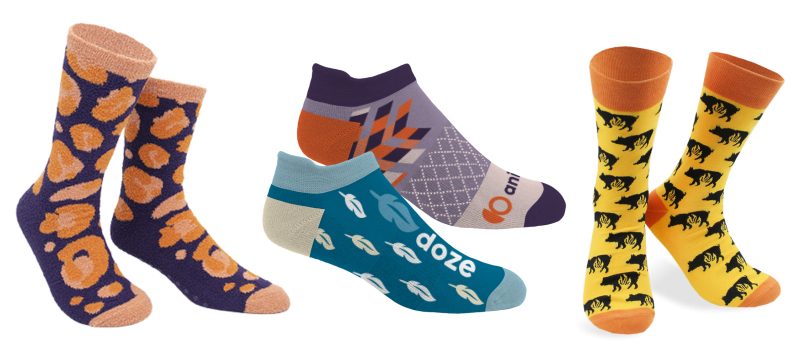 First, let’s get a baseline on the three different ways to offer product choice in a campaign. To do this, I will provide a simple illustration. Let’s say a university had provided socks to donors in the past and now wants to offer donors three options to choose from with their donation. Their options include;
- Offering the same sock with three different artwork designs.
- Have three different types of socks to choose from. For example, a no-show sock, dress sock and athletic sock.
- Provide a sock option and two other similarly valued products. For example, a t-shirt and garden flag.
Once the college has decided on what direction that they want to go in, there are a key few strategies and best practices to think through to create success. These include:
Ordering Exact Quantities – To alleviate unnecessary inventory, we always recommend holding off on running production quantities until the campaign ends. This way the exact amount of needed merch is put into production. This strategy works perfectly to allow apparel to be one of the choice options. This is important because when we surveyed donors, apparel was the most coveted product category. With the longer time between donation and the receiving of the merch, set donor delivery expectations through clear timeline communication. This would start from the time of the donation with frequent updates until the product mails.
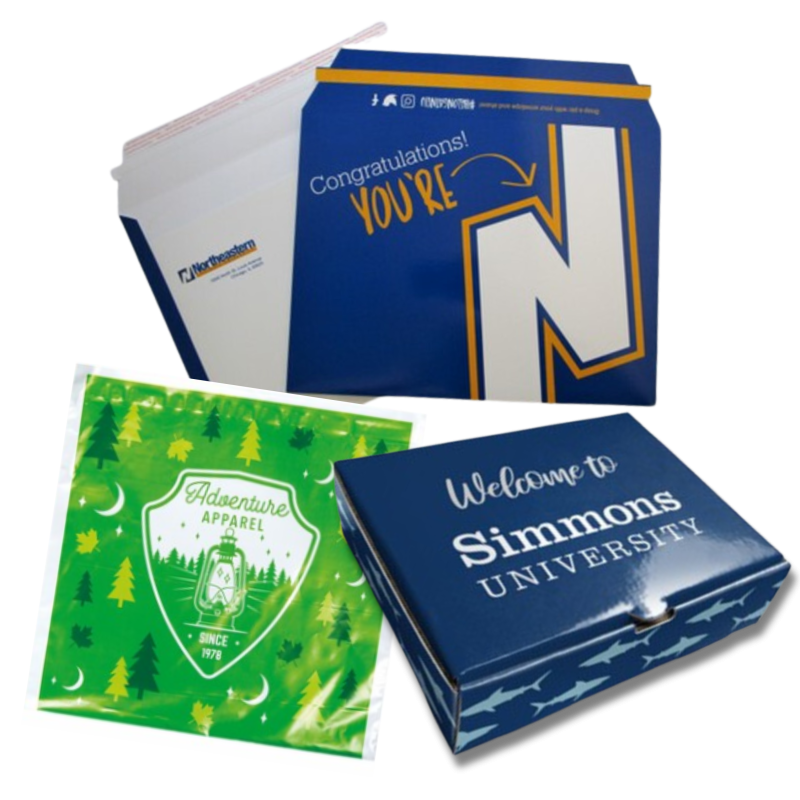 Fulfillment and Packaging – Streamline the fulfillment on the product options by using the same packaging for all of the products chosen. For example, if the choice is to mail the products in a polymailer, ensure all of the products can fit in the same size packaging. This way the same packaging is used for the entire project. This will reduce the cost of the packaging and the speed of the fulfillment.
Tiered Conversion – A choice campaign can be easily converted to a tiered merch program. Since multiple products are offered, allowing the donor to donate more to receive additional products can be easily integrated. For example, a campaign offers a choice of three items with a donation of $100. If the donor gives $225, then the donor can choose two of the options. Then a $350 gift allows the donor to receive all three! Not only does the donor get to receive more merch to show off, this strategy can result in larger donation amounts from those who are incentivized by the additional merch.
Collecting and Transferring Data – Ensuring the quick and easy transfer of the donor data when a campaign is closed is really important. The data needs to be collected so it can be easily sorted and formatted to be ready for mailing. This can be accomplished through a CRM integration (for example Slate) that is tied into the campaign or use a choice store platform.
Marketing the Choice – Make sure that the marketing for the campaign features that the donor has a choice of merch with their donation. Since it is a benefit to the donor and the campaign to offer choice, the marketing of the campaign needs to ensure that this messaging is apparent.
Economies of Scale – It is true that the cost for the products may be slightly higher since the quantities are being split up amongst a group of items. One strategy to offset this is slightly raise the donation amount to receive the merch. This can be accomplished for as low as $5. That small of a nominal increase would more than offset any additional costs for offering a choice campaign. And in effect, would raise the donation amounts given by donors.
Offering merch choice for donations is more complicated, but through a thoughtful approach to the campaign, the process can be smooth and efficient. This results in a campaign that will be highly appreciated by donors. Maximizing donations with merch choice