

One of my longest and closest higher ed connections is Liz Gross, Founder & CEO of Campus Sonar. We met when I was working to break into the higher ed space with the University of Wisconsin–Milwaukee, our first collegiate client. At the time, Liz worked in Residence Life and helped us get our start there, and we’ve stayed close ever since.
I love how Campus Sonar uses social media data to understand how students think about colleges and generates insights that help institutions reach the right prospects and boost enrollment. Over the years, I’ve watched Liz and her team help colleges use social listening to uncover what truly influences student decisions – a perfect complement to the role branded merch plays in shaping perception and belonging.
Recently, Campus Sonar published Attracting Students in a Peer-influenced Market: Drivers of College Choice and Value Perception. As I reviewed it, I could not help but reflect on the power of merch and how it plays into the social intelligence-powered recommendations.
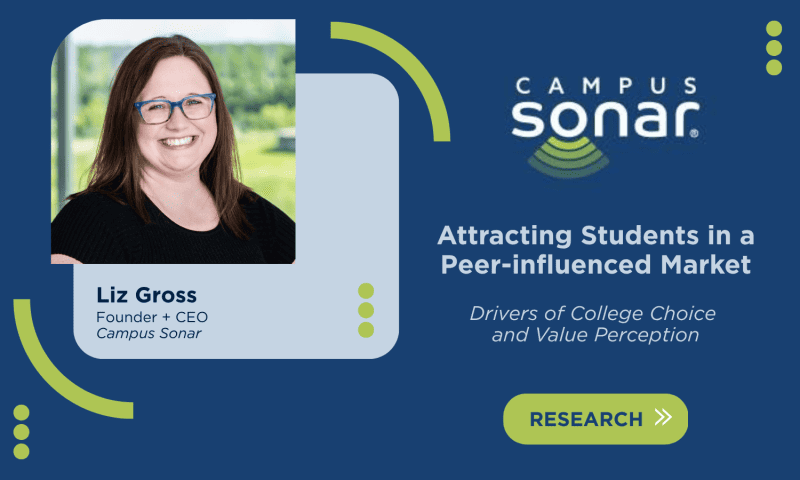
Campus Sonar analyzed more than 600,000 conversations on online forums about college admissions from May 2023 through May 2024. One of the emerging themes they discovered in those conversations centers on belonging and community.
This is right in our wheelhouse as branded merch plays a key role in fostering that connection. Merch is a long-lasting, tangible, visible, and appreciated marketing piece that allows families and students to showcase their pride and feel part of their college tribe – both on and off campus.
With our extensive collegiate experience, I wanted to share a few influential examples of community building.
Augusta University’s Curated Deposit Experience – Creating community and engaging both parents and students is important to Augusta University. To ensure this is done effectively, they have consistently deployed a well-curated and thoughtful committed student mailer. It starts with a box that features fun artwork that looks like a suitcase. Inside, the box includes an Augusta sweatshirt, a custom-created Augusta calendar with helpful dates, a book on the topic of transitioning to college, a magnet and an insert card that welcomes the family.
St. Catherine’s Slate Powered Bracelet Program – To help students start feeling part of their community, St. Kate’s leveraged custom query automation in Slate to build engagement in two stages of the funnel. When students filled out their FAFSA and/or when deposited, they received a friendship bracelet—each stage featuring a unique version. Learn more about this strategy HERE.
George Washington University’s Sustainable Choice Store – To celebrate admitted students and build community, GW created a custom online store where each student could choose one eco-friendly item – a t-shirt, tote, journal, or beanie – made from recycled materials. The personalized experience, complete with a branded package and a note from the university, generated excitement and pride, with 60% of the incoming class participating. Read the full story HERE.
St Bonaventure’s Collect the Fit – Branded apparel is one of the most effective ways to show your pride. St. Bonaventure created a full-funnel apparel strategy designed to help students begin to feel part of the community. Learn more HERE.
These examples show how intentionally branded merch can do more than generate excitement – it can spark belonging, pride, and genuine connection. When paired with the kind of social insight Campus Sonar provides, merch becomes a powerful way for colleges to turn outreach into impact and ensure every student feels part of something bigger from the very start.